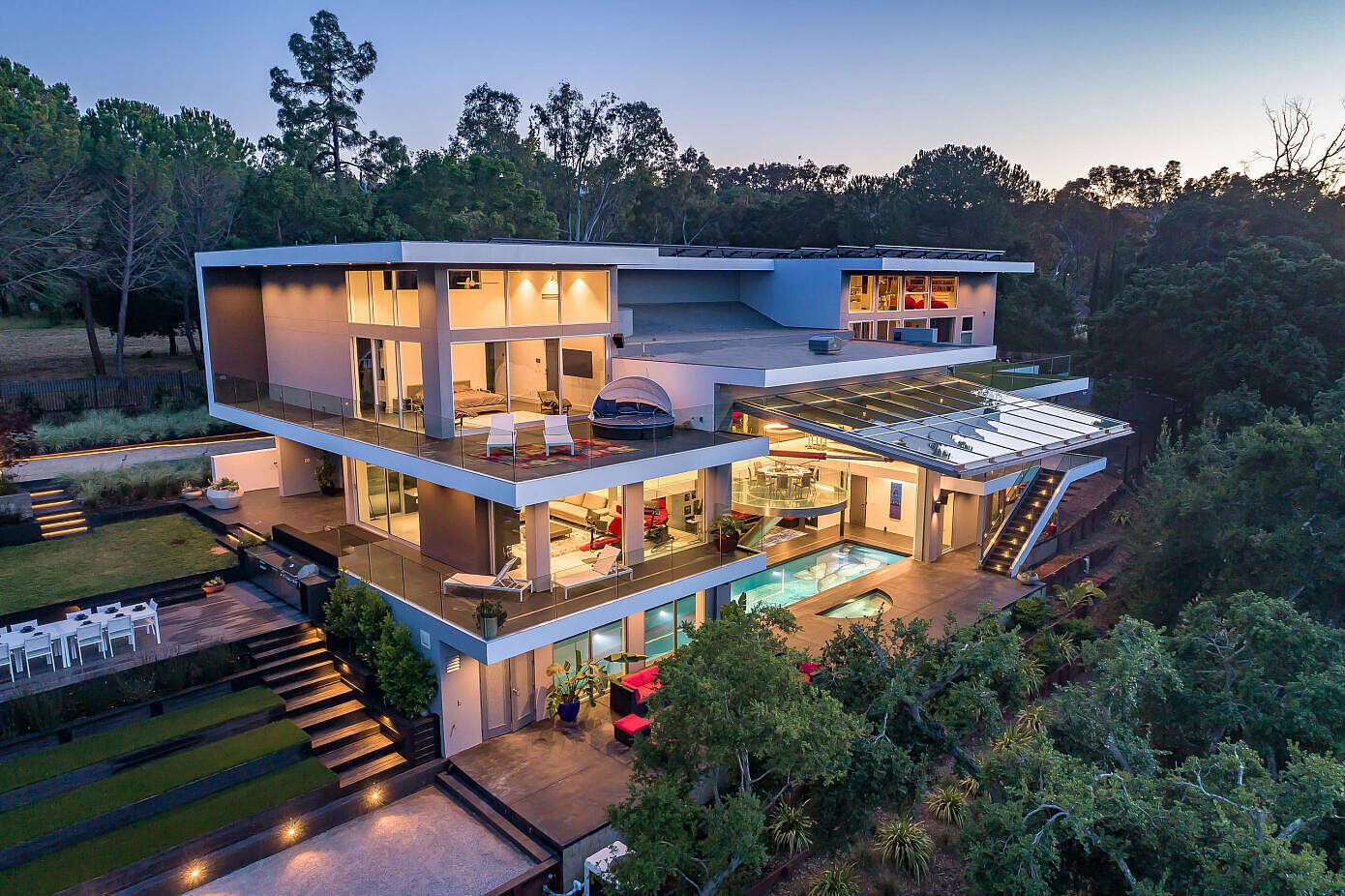
The mature canopy is a large part of what people are paying for on this side of the Bay. It is also, on most of these lots, the most regulated feature of the property — more binding in practice than the setback lines, and far more likely to change what you can actually build.
Every city I work in has its own tree protection ordinance, and they are not variations on a single theme. The species lists differ. The size thresholds differ. The approval body differs — in one town a staff planner signs off, in the next it goes to a public Planning Commission hearing. What they share is the part buyers underestimate: a protected tree is not just a tree you may have to pay to remove. It is a fixed point that the house has to be designed around.
Four cities, four rulebooks
A short tour, to show how much the answer moves across a few miles:
- Palo Alto protects specific species at specific sizes — coast live oak and valley oak at roughly 11.5 inches diameter, along with coast redwood and, since a 2022 update, several additional natives including blue oak, California black oak, bigleaf maple, and incense cedar. Removal requires a permit and a supportable finding.
- Los Altos lowered its general protected-tree threshold from 15 inches to 12 inches of trunk diameter in a 2024 update, with a lower bar still — around 10 inches — for native oaks and California buckeye. Permit applications generally require an arborist report and a public notice period.
- Menlo Park uses a "heritage tree" definition keyed to size, with non-oak species generally protected at 15 inches diameter and natives treated more strictly. Major pruning counts: removing more than about a quarter of a heritage tree's crown or roots requires a permit, not just felling it.
- Atherton is the strictest of the four. Oaks are protected essentially regardless of size, removals go to a Planning Commission hearing, and heritage oaks and redwoods removed from the buildable area carry mandated replacement planting.
These figures move. Los Altos changed its threshold recently; Palo Alto has revised its ordinance more than once this decade in both directions. Treat any number you read — including the ones above — as a starting point to confirm with the city's urban forestry or planning division for the specific parcel, on the day you need the answer.
The part that costs real money: the protection zone
Most buyers fixate on whether a tree can come down. The expensive question is usually what happens to the trees that stay.
Cities protect a retained tree by establishing a tree protection zone — a fenced radius, typically scaled off trunk diameter, extending well past the trunk into the root plate. Inside that zone, grading, trenching, soil compaction, material storage, and equipment traffic are restricted or prohibited outright. That is not a formality. It can mean a basement excavation moves, a driveway reroutes, a utility trench takes the long way around, a foundation system changes, or a crane sets up somewhere less convenient and slower.
I have watched that arithmetic decide projects. A lot with three protected oaks in a loose triangle across the buildable envelope may technically allow a large house, and still be a genuinely hard site to build — because the shape left over once you honor the protection zones is not the shape anybody wants to live in.
Schedule, replacement, and the penalty side
Three practical consequences worth pricing before you commit.
Time. Where a removal is discretionary and noticed — or in Atherton's case, heard by the Planning Commission — you are adding weeks to months, and you are adding appeal risk. A neighbor with standing to appeal is not a rare event in these towns.
Replacement. Approval frequently comes with conditions: replacement trees at specified sizes and ratios, planted in approved locations, sometimes with an in-lieu fee where the site can't accommodate them. On a tight lot, replacement obligations consume landscape area you had planned to use for something else.
Penalties. Unpermitted removal is one of the few mistakes in this business that cannot be unwound. Fines are significant, replacement is mandatory, and in some jurisdictions a violation can hold up the building permit for the project the tree was in the way of. If a seller or a contractor suggests handling a tree quietly before close, the correct answer is no — and it is worth understanding why they raised it.
What to do during the contingency period
On any wooded lot where you intend to build, remodel significantly, add an ADU, or reconfigure a driveway, four steps belong in your due diligence window:
- Get an arborist out. An inventory with species, trunk diameter at standard height, condition, and mapped protection zones. A few hundred dollars against a project of this size is not a close call.
- Read the actual ordinance for that city — not a summary, and not what the ordinance said three years ago.
- Overlay the protection zones on a conceptual footprint before you are emotionally committed to a floor plan. This is the single most useful hour in the whole process.
- Ask the city directly. Planning and urban forestry staff in these towns will generally tell you how a given tree is likely to be treated. That conversation is free and it is early.
Done in that order, the canopy becomes what it should be: a large part of what makes the property worth owning, and a known constraint rather than a discovered one. Done afterward, it becomes a redesign.
Looking at a wooded lot or a teardown?
I can help you read the trees, the ordinance, and the buildable envelope together — before you write, not after.
Start a ConversationSources & Further Reading
City of Palo Alto — Tree Preservation & Protected Trees →City of Los Altos — Tree Removal Permits →City of Menlo Park — Heritage Tree Definition & Ordinance (Ch. 13.24) →Town of Atherton — Municipal Code Ch. 8.10, Heritage Trees →Town of Los Altos Hills — Tree Removal Permit →Payne Sharpley is a Silicon Valley real estate agent with Intero | Forbes Global Properties and co-founder of Citis, a housing-entitlement intelligence platform. CA DRE #02195155. This article is general information, not legal, tax, or land-use advice; tree protection ordinances, protected species lists, size thresholds, permit procedures, and replacement requirements change frequently and are city- and parcel-specific — verify all specifics with the applicable city's planning or urban forestry division, a licensed arborist, and your own counsel before relying on them. Equal Housing Opportunity.